Commercial solar
Commercial solar panels, worked out properly
We help you work out whether solar stacks up for your business, with real figures on cost, return and payback. From warehouse roofs to office blocks, the work is carried out by accredited installers. You decide in your own time.
- Accredited installers
- No obligation
- UK-wide
Why go solar
What solar gives your business
Cut your operating costs
Electricity is a major overhead for most businesses. Generating your own cuts it from day one, and a well-sized system can cover a large share of your daytime demand.
A faster return than a home
Businesses use most of their power in the day, exactly when solar is generating, so you use more of what you make. That is why commercial payback is often quicker, frequently in the region of 5 to 8 years.
Protection from price swings
Producing a chunk of your own power shields part of your energy costs from a volatile market, which makes budgeting more predictable.
Net-zero credentials
On-site generation is a visible, measurable step toward carbon targets, the kind customers, staff and tender processes increasingly ask about.
Your building
Is your site suitable?
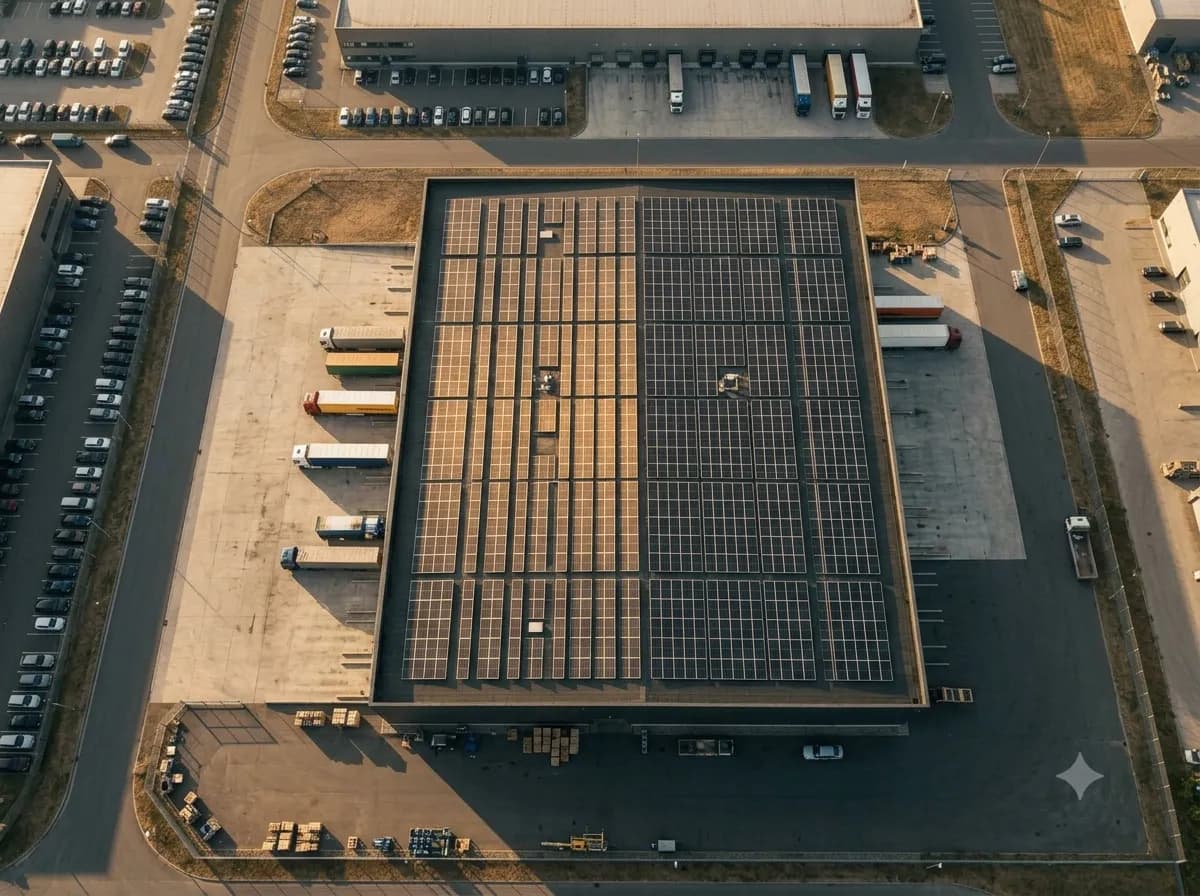
Large flat industrial and warehouse roofs are close to ideal, with the space for a big system and simple access. Pitched factory, agricultural and office roofs work well too, and if you have unused land, a ground-mounted array is an option.
The main things a survey checks are the amount of usable roof, its structural loading, and how much of your demand falls in daylight hours. As a rule, the more roof you have and the more power you use in the day, the stronger the case.
- Warehousing & logisticsBig roofs, and the export and PPA models that suit them
- ManufacturingHeavy daytime use, the strongest payback case
- AgricultureBarn roofs, permitted development, daytime loads
- OfficesA nine-to-five load that matches generation
- Retail & hospitalityHotels run all day, so most generation is used on site
- Education & public sectorThe funding routes for school solar, explained
What it costs
What commercial solar panels cost
Cost depends on your roof, site and system size, so the assessment works out the figure for your building. But at commercial scale there is a useful planning band, and as a rule the bigger the system, the lower the cost per kW.
| System size | Typical use | Indicative installed cost | Per kWp |
|---|---|---|---|
| 30 kWp | Small office or farm building | £33,000–£40,000 | ~£1,100–£1,300 |
| 100 kWp | Warehouse or mid-size factory | £85,000–£105,000 | ~£900–£1,050 |
| 250 kWp | Large industrial roof | £190,000–£240,000 | ~£800–£950 |
Indicative 2026 planning ranges from typical UK installer pricing, excluding VAT. A grid connection (a G99 application) and any structural work can add cost, and battery storage is priced separately. Figures reviewed July 2026.
A worked example
Take a 100 kWp system on a mid-size factory or warehouse roof, costing around £95,000.
- about 250 panels
- 100 kWp
- kWh a year
- ~90,000
- saved a year
- ~£18,000
- payback
- ~5 yrs
It generates roughly 90,000 kWh a year. A business like this uses about three quarters of that on site, worth around 25p a unit against the grid, and exports the rest for a few pence through the Smart Export Guarantee. That works out at roughly £18,000 a year, a payback of about five years, on panels that keep generating well beyond 25.
Your figures depend on your own roof, tariff and usage. The assessment works them out for your building rather than leaning on an average.
What makes the return strong is self-consumption. Because a business uses most of its electricity in the day, when the panels generate, you use far more of what you produce than a home does. That is why commercial payback is usually quicker, often in the region of 5 to 8 years and sometimes faster.
How you pay
Three ways to fund it
Unlike a home install, a business has real choice in how to pay, and the right one depends on your cash position and how you treat capital.
Buy outright
You own the system and keep all the savings. Commercial solar can also qualify for capital allowances, letting you offset much of the cost against taxable profits. It is worth confirming the current rules with your accountant.
Finance or lease
Spread the cost with asset finance or a lease, so the savings the system produces help cover the repayments rather than a large upfront outlay.
Power Purchase Agreement
A third party funds, installs and owns the system on your roof, and you simply buy the power it generates at a rate below the grid. No upfront cost, though you own less of the long-term saving.
How it works
From enquiry to installed
- 01
Request an assessment
Tell us about your site, your roof and roughly what you spend on electricity. It takes a few minutes and there is no obligation.
- 02
Site survey and feasibility
An accredited installer checks the roof and its structure, looks at your half-hourly energy data, and handles the grid connection. Larger systems need approval from the network operator (a G99 application), not just a notification.
- 03
Proposal, then you decide
You get a detailed proposal with the system size, cost, expected output and return, to weigh in your own time. If it does not stack up, you walk away.
- typical payback
- 5–8 yrs
- panel lifespan
- 25+ yrs
- upfront with a PPA
- £0
Common questions
- Is commercial solar worth it?
- For most businesses with a decent roof and daytime electricity use, yes. Because you use much of what you generate as you generate it, payback is often in the region of 5 to 8 years, and the panels keep working well beyond 25.
- How much do commercial solar panels cost?
- At commercial scale, installed cost is typically around £800 to £1,300 per kW in 2026, and lower per kW as the system gets bigger. A 30 kWp system runs roughly £33,000 to £40,000, and a 100 kWp system around £85,000 to £105,000. The exact figure depends on your roof and grid connection, which is what the assessment works out for your building.
- How long is the payback on commercial solar?
- Often around 5 to 8 years, and sometimes faster for businesses that use a lot of power in the day. It is quicker than a typical home because you self-consume more of what you generate rather than exporting it.
- What is a Power Purchase Agreement (PPA)?
- A funder installs and owns the system on your roof at no upfront cost to you, and you buy the electricity it produces at an agreed rate, usually below the grid price. You save from day one without the capital outlay, but you own less of the long-term benefit than buying outright.
- Can my business get tax relief on solar?
- Yes. Solar counts as special-rate plant for capital allowances, so it does not qualify for full expensing, but a company can usually claim the Annual Investment Allowance, currently £1 million a year, which gives 100% relief on the cost in the first year up to that limit. Above the limit, special-rate assets get a 50% first-year allowance with the balance written down over time. The exact benefit depends on your profits, so confirm the detail with your accountant.
- Are there grants for commercial solar panels?
- There is no general grant for commercial solar in the UK. For businesses, the main support is the tax relief through capital allowances, plus the Smart Export Guarantee, which pays you for the electricity you export. Public-sector organisations like schools and hospitals have their own funding routes. Schemes change, so it is worth checking the current position rather than assuming.
- Do I need planning permission for commercial solar?
- Roof-mounted solar on many commercial buildings is permitted development, but larger systems, ground-mounted arrays, and listed or conservation-area sites often need permission. Larger systems also need grid-connection approval. Your installer confirms both.
- Will installation disrupt my operations?
- It is planned to keep disruption to a minimum. Most of the work is on the roof, and the connection is scheduled around your business. Your installer sets out the timeline before anything starts.
- Who carries out the work?
- The work is carried out by accredited installers experienced in commercial systems. They handle the survey, the structural checks, the installation and the grid connection.
Sources
See whether solar stacks up for your business
Tell us about your site and roughly what you spend on electricity, and we will help you work out the cost, output and return. Free, no obligation, and the work is carried out by accredited installers.