Commercial solar
Agricultural solar panels for UK farms
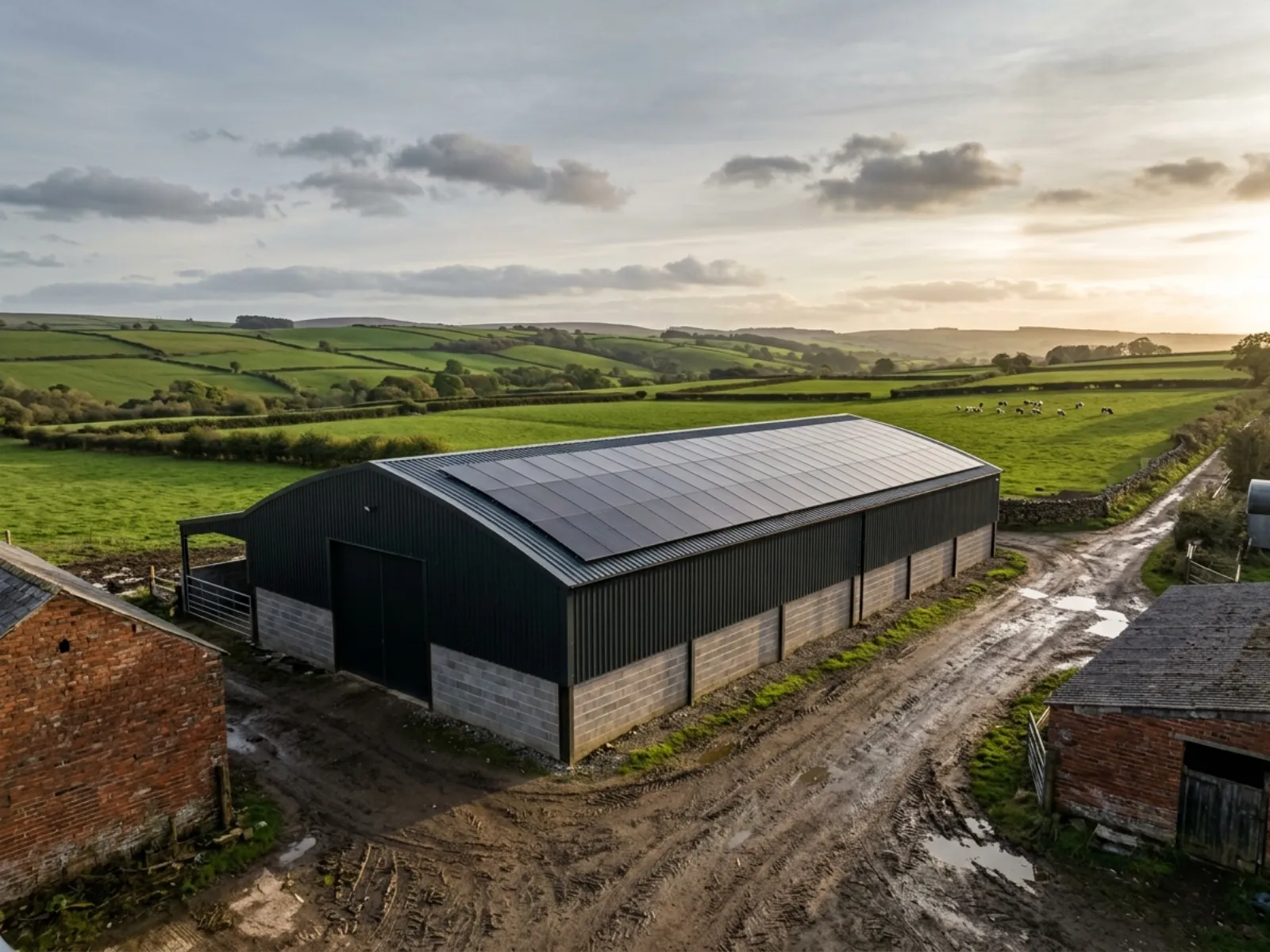
Barn and outbuilding roofs are large, simple and unshaded, which makes them well suited to solar. Whether it pays back quickly or earns its keep through export depends on how much power the farm uses in daylight.
- Accredited installers
- No obligation
- UK-wide
- typical system
- 20–200 kWp
- typical payback
- ~6–8 yrs
- often on barn roofs
- Permitted dev.
Why farms suit solar
A farm often has more roof than it knows what to do with, and it comes without the shading and access headaches of a town-centre site. Big, simple barn and shed roofs take a sizeable array at a low cost per kW.
The economics turn on daytime demand. A dairy with refrigeration and milking, or an arable farm running grain drying and irrigation in season, uses a lot of power in daylight and self-consumes well. A farm with little daytime load exports more, which is where the export rate, or a ground-mounted array on marginal land, comes into the picture as diversification income.
A worked example
Take a 50 kWp system on a barn roof, costing around £57,000.
- about 125 panels
- 50 kWp
- kWh a year
- ~45,000
- saved a year
- ~£8,500
- payback
- ~6–7 yrs
It generates roughly 45,000 kWh a year. A farm with steady refrigeration or processing load uses around 70% on site, worth about 25p a unit, and exports the rest through the Smart Export Guarantee, coming to roughly £8,500 a year.
A farm with less daytime demand keeps a smaller share and exports more, so the payback lengthens but the roof still earns. If daytime use is low, adding a battery or looking at ground-mount for scale can change the picture, which the assessment weighs against your actual usage.
Assumes a business electricity price of about 25p a unit (DESNZ Quarterly Energy Prices), export at around 5p a unit through the Smart Export Guarantee, and a yield of about 900 kWh per kWp a year. Your own figures depend on your roof, tariff and usage. Reviewed July 2026.
Planning and your supply
Rooftop solar on a farm building is treated as solar on a non-domestic building, which is often permitted development under the planning rules, though larger or ground-mounted schemes and any listed or protected buildings can need a full application. Your installer confirms the position for your site.
Rural supplies are worth checking early. Many farms are three-phase, which suits a bigger system, but some are on a single-phase or a constrained rural network, and a larger array needs approval from the network operator before it connects. That is planned into the project.
How you pay
Buying outright suits a farm that can use the capital allowances against taxable profits, while finance or a lease spreads the cost against the savings. On a low-daytime-use farm, export income and diversification may matter as much as the bill saving.
Related guides
Common questions
- Do I need planning permission for solar on a barn?
- Often not. Rooftop solar on an agricultural building is treated as solar on a non-domestic building, which is frequently permitted development. Larger schemes, ground-mounted arrays, and listed or protected buildings can still need a full application, so your installer checks the position for your specific site before anything is committed.
- Can I put solar on farmland rather than a roof?
- Yes, a ground-mounted array on marginal or less productive land is an option, and it can scale beyond what your roofs allow. Ground-mount is more likely to need planning permission and a grid-connection study, so it is assessed separately from a simple rooftop system.
- Does it work with a rural three-phase supply?
- A three-phase supply suits a larger system and is common on farms. A larger array needs approval from the network operator (a G99 application) before it connects, and rural networks can occasionally be constrained, so the connection is checked early as part of the feasibility work.
- Are there grants for farm solar?
- There is no general grant for farm solar in the UK. The main support is the tax relief through capital allowances, plus the Smart Export Guarantee for the power you export. Rural and agricultural funding schemes come and go, so it is worth checking the current position rather than assuming one exists.
Sources
Reviewed by Daniel Osei · Last checked July 2026. Funding and tax rules change, so we re-check this page regularly and date it when we do.
See whether solar stacks up for your site
Tell us about your building and roughly what you spend on electricity, and we will help you work out the cost, output and return. Free, no obligation, and the work is carried out by accredited installers.