Commercial solar
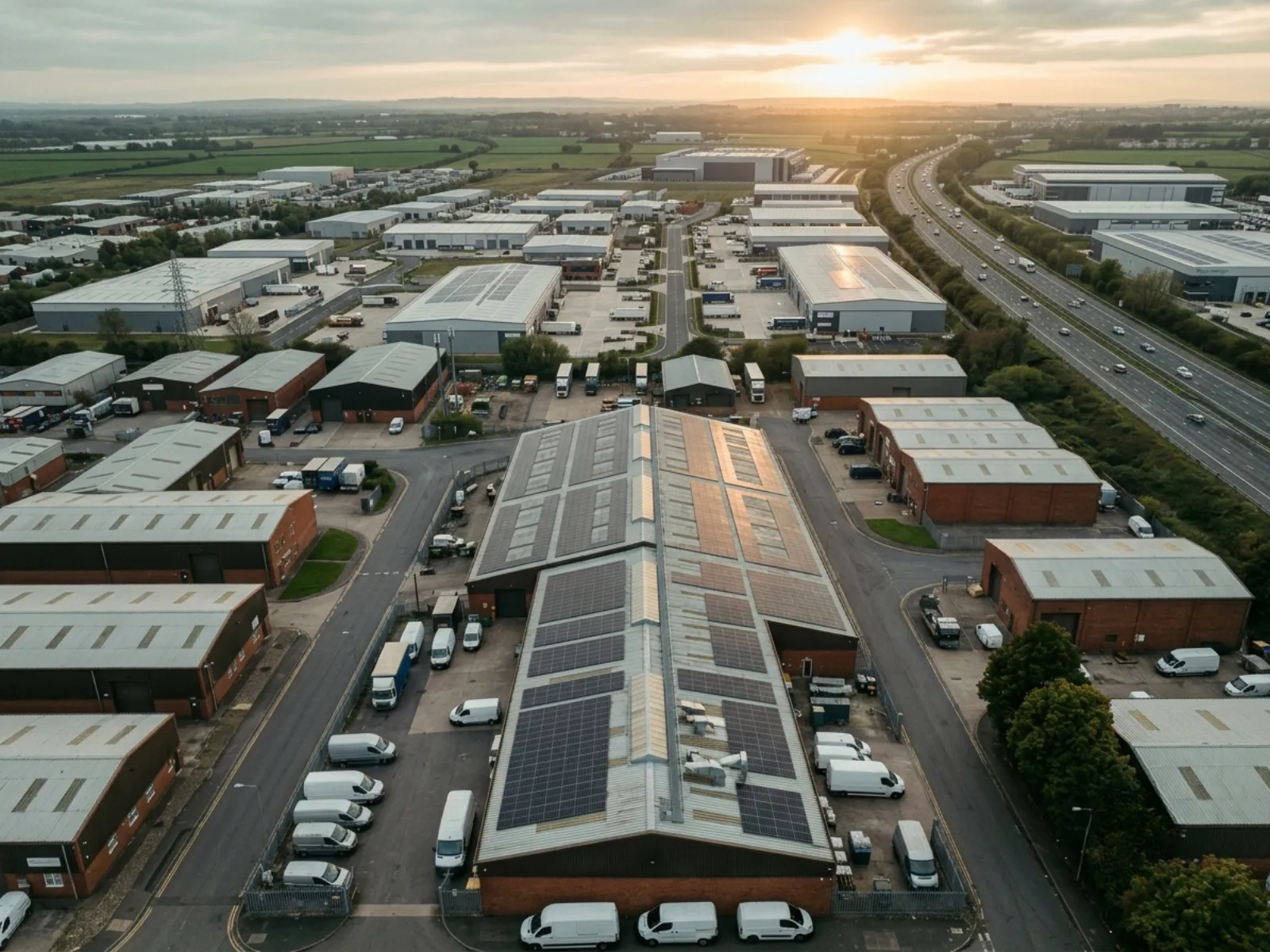
Solar panels for factories and manufacturing
Manufacturing is the strongest payback case in commercial solar. A factory runs heavy, continuous machinery through the day, exactly when the panels generate, so you use most of what you produce rather than exporting it cheaply.
- Accredited installers
- No obligation
- UK-wide
- typical system
- 50–300 kWp
- typical payback
- ~4–6 yrs
- self-consumption
- 75–95%
Why factories get the best return
Compressors, motors, ovens, extraction and process lines hold demand high right across the solar day. That means most of what the panels generate is used on site, displacing electricity you would otherwise buy at the full business rate rather than exporting it for a few pence.
Self-consumption in the region of 75 to 95% is common for continuous or shift-based operations, and it is what pulls payback toward the bottom of the range. For an energy-intensive site, solar also hedges a real slice of a volatile cost.
A worked example
Take a 200 kWp system on a factory roof, costing around £180,000.
- about 490 panels
- 200 kWp
- kWh a year
- ~180,000
- saved a year
- ~£40,000
- payback
- ~4–5 yrs
It generates roughly 180,000 kWh a year. A working factory uses around 85% of that on site, worth about 25p a unit against the grid, and exports only the small remainder. That is in the region of £40,000 a year, a payback of about four to five years, on panels that keep generating well beyond 25.
The higher and steadier your daytime load, the closer you get to using everything the panels make. Sharing half-hourly meter data lets the assessment size the system to your real demand rather than a rule of thumb.
Assumes a business electricity price of about 25p a unit (DESNZ Quarterly Energy Prices), export at around 5p a unit through the Smart Export Guarantee, and a yield of about 900 kWh per kWp a year. Your own figures depend on your roof, tariff and usage. Reviewed July 2026.
What a survey checks
Alongside the roof area and its structural loading, the survey looks at your half-hourly consumption to match the system to your demand, and at your supply. At this scale most sites are three-phase, and connecting a larger system needs approval from the network operator (a G99 application) before it energises, not just a notification.
That approval is a normal part of the timeline rather than an obstacle, and the installer handles it. It just means a commercial connection is planned in, not switched on the same week.
How you pay
A strong, fast payback makes buying outright attractive, and the cost can usually be set against taxable profits through capital allowances. Finance or a lease spreads the cost so the savings help cover the repayments.
Related guides
Common questions
- Will solar cover our whole electricity use?
- Rarely all of it. Roof space usually limits the system to a share of a factory’s demand, and the panels only generate in daylight, so you still buy power at night and in winter. The value is that a heavy daytime load uses almost everything the panels make, which is what drives the strong payback.
- What about shift patterns and weekends?
- Continuous or multi-shift operations are close to ideal, because there is always daytime load to absorb the generation. A single-shift or weekday-only site exports more at the quieter times, which the assessment accounts for by sizing to your actual half-hourly data.
- How long does grid approval take?
- A commercial-scale system connects under the network operator’s G99 process, which needs approval before it energises. The timescale varies by network operator and system size, so it is planned into the project rather than assumed, and your installer manages the application.
- Can we claim tax relief on a factory system?
- Usually yes, if you are a company paying tax. Solar is special-rate plant, so it does not qualify for full expensing, but the Annual Investment Allowance (currently £1 million a year) can give 100% relief on the cost in the first year up to that limit. Confirm the detail with your accountant.
Sources
Reviewed by Daniel Osei · Last checked July 2026. Funding and tax rules change, so we re-check this page regularly and date it when we do.
See whether solar stacks up for your site
Tell us about your building and roughly what you spend on electricity, and we will help you work out the cost, output and return. Free, no obligation, and the work is carried out by accredited installers.