Commercial solar
Solar panels for schools and colleges
For a school, the funding is the real question, not the panels. State schools do not pay tax, so the business tax reliefs do not apply, and the routes are a mix of government programmes, interest-free loans and capital budgets. Here is how they actually work.
- Accredited installers
- No obligation
- UK-wide
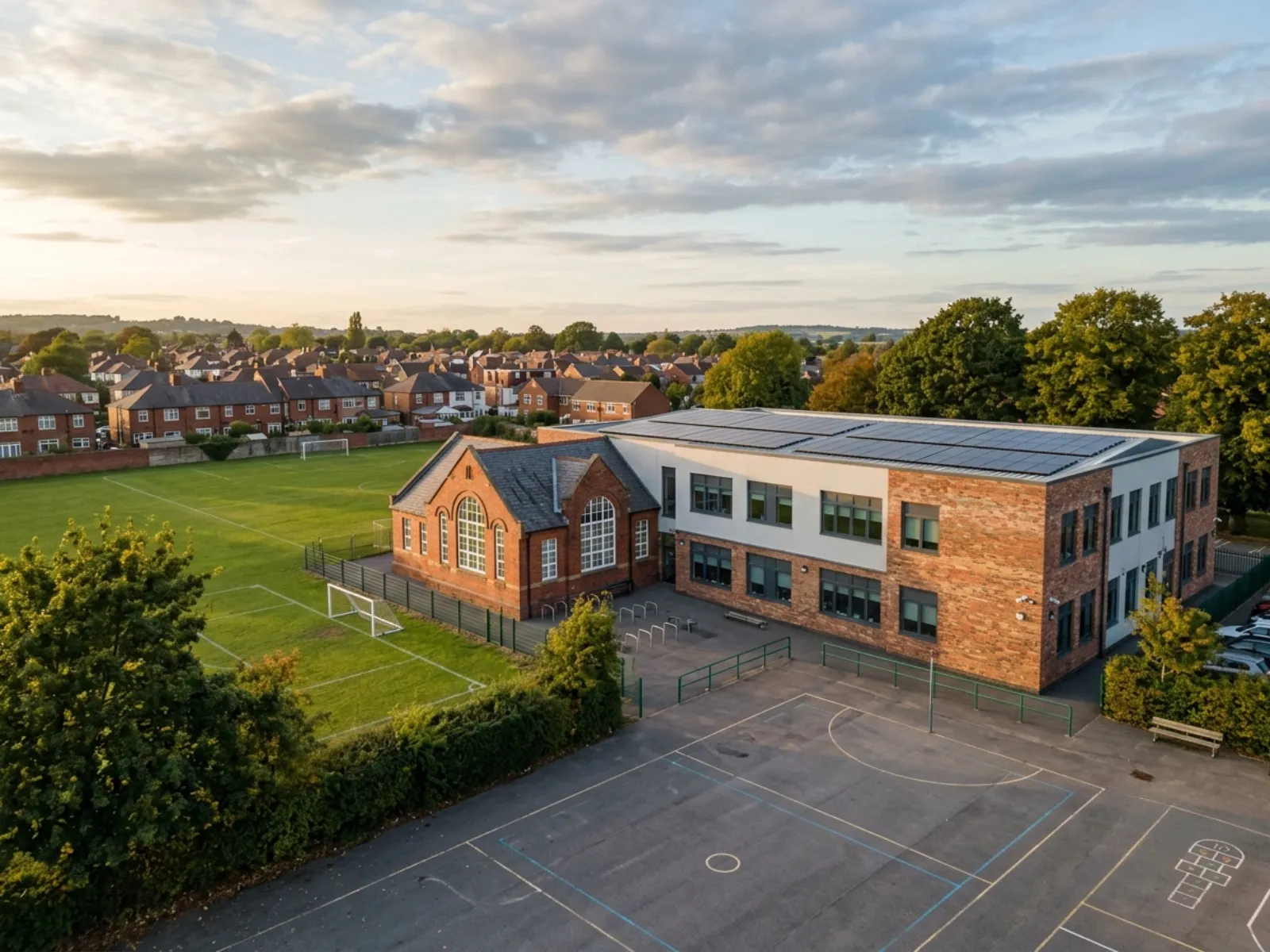
- typical system
- 20–100 kWp
- grants, loans, capital
- Funded routes
- holiday export
- Term-time load
How schools pay for solar
The headline route in 2026 is Great British Energy, the publicly owned energy company, which is funding rooftop solar on around 200 schools (and a similar number of hospitals). It is real, government-funded solar, but schools are selected centrally by the Department for Education, not an open scheme any school can apply to, so it is worth knowing about rather than banking on.
Beyond that, Salix Finance offers public bodies interest-free loans for energy-efficiency work, repaid from the savings, which is a loan rather than free money. The Public Sector Decarbonisation Scheme has funded school solar in the past but is in delivery only, with no open round. And a school’s own capital budgets, the Condition Improvement Fund for academies and small trusts, or School Condition Allocations and Devolved Formula Capital for others, can fund energy works where they fit the priorities.
These funding routes apply in England. Scotland, Wales and Northern Ireland run their own school funding and building-decarbonisation arrangements, so the specifics differ there.
A worked example
Take a 100 kWp system on a secondary school roof, costing around £95,000 before any funding.
- about 250 panels
- 100 kWp
- kWh a year
- ~90,000
- saved a year
- ~£15,000
- not payback-led
- Funding-led
It generates roughly 90,000 kWh a year. During term time the weekday daytime load uses a good share on site, but the summer holidays are the catch: generation peaks in July and August exactly when the school is quietest, so more is exported then. Across the year a school uses a bit over half on site, worth around 25p a unit against the grid, and exports the rest for a few pence through the Smart Export Guarantee. That saves in the region of £15,000 a year.
That gives a payback of around six years if a school buys outright, but for most schools the decision turns on the funding route rather than the payback. Where a system is grant-funded, the saving is immediate; where it is loan or capital funded, the repayment is set against the saving.
Assumes a business electricity price of about 25p a unit (DESNZ Quarterly Energy Prices), export at around 5p a unit through the Smart Export Guarantee, and a yield of about 900 kWh per kWp a year. Your own figures depend on your roof, tariff and usage. Reviewed July 2026.
Who decides, and the practicalities
Who approves and pays differs by school type. An academy or trust decides for itself and can apply to funds like the Condition Improvement Fund; a local-authority-maintained school works through the authority, which holds the relevant capital. Church and voluntary-aided schools add the diocese or trust to the mix.
Third-party rooftop leases and Power Purchase Agreements for schools carry extra consent requirements, so the "free solar" offers that appear are not always as simple as they look, and the current Department for Education position is worth checking before signing anything. Installs are typically scheduled for the holidays, and the work is external.
How you pay
Because state schools do not pay corporation tax, the capital allowances that help a business do not apply. Instead there are four routes worth knowing, and the right one depends on your school type and timing.
Great British Energy
The publicly owned energy company is funding rooftop solar on around 200 schools in 2026. Genuinely government-funded, but schools are selected centrally by the Department for Education, not an open scheme you apply to.
Salix interest-free loans
Salix Finance lends public bodies the cost of energy-efficiency work at 0% interest, repaid from the energy savings. No capital outlay, but a loan rather than free money.
School capital budgets
The Condition Improvement Fund (academies and small trusts) and School Condition Allocations or Devolved Formula Capital (others) can fund energy works where they fit the school’s priorities.
Lease or PPA
A third party funds and owns the system, and you buy the power below grid price or rent out the roof. For schools these carry extra consent requirements, so check the current DfE position before signing.
Solar panels for office buildings
A similar weekday-daytime load, with the EPC and ESG angle, on the commercial side.
Solar panels for hotels and hospitality
Another building that runs long hours, where a continuous daytime load lifts the return.
Related guides
Common questions
- Is there free solar for schools?
- Sort of. Great British Energy, the publicly owned energy company, is funding rooftop solar on around 200 schools in 2026, which is genuinely government-funded rather than a loan. But schools are chosen centrally by the Department for Education, so it is not an open scheme any school can apply to. Other "free" offers are usually third-party leases or PPAs, which are commercial arrangements, not grants, and need approval.
- Are there grants for school solar?
- Some routes exist, but they change. Great British Energy funds a set number of schools directly; the Public Sector Decarbonisation Scheme has funded school solar but has no open round; and Salix offers interest-free loans repaid from savings. A school’s own capital budgets can also fund energy works. It is worth checking the current position, since these schemes open and close.
- Can an academy install without local-authority approval?
- Generally yes. Academies and trusts are responsible for their own buildings and budgets, and can apply directly to funds like the Condition Improvement Fund. A local-authority-maintained school works through the authority instead, which holds the relevant capital funding. The right route depends on your school’s type.
- Can a school claim tax relief on solar?
- No. State schools and academies do not pay corporation tax, so the capital allowances that let a business offset the cost against its profits do not apply. That is exactly why the school routes are grants, interest-free loans and capital budgets rather than tax relief. An independent (fee-paying) school that trades may be different, and should ask its accountant.
- What happens to the solar in the school holidays?
- Generation is highest in summer, exactly when the school is quietest, so more is exported to the grid during the holidays and earns the export rate rather than displacing your own use. It is a real effect that lowers the average self-consumption, and it is why a school’s numbers look different from a factory’s.
- Can it be installed in term time?
- It can, but most schools schedule the install for the holidays to keep the site clear. The work is external and on the roof, so it does not disrupt classrooms, and the timeline is planned around the school calendar.
Sources
Reviewed by Daniel Osei · Last checked July 2026. Funding and tax rules change, so we re-check this page regularly and date it when we do.
See whether solar stacks up for your site
Tell us about your building and roughly what you spend on electricity, and we will help you work out the cost, output and return. Free, no obligation, and the work is carried out by accredited installers.