The complete guide
Solar panel installation: start to finish
By Daniel Osei · Last checked 30 June 2026 · About a 10 minute read
Most people come to solar with the same questions, in the same order. Will it even work on my roof? What will it cost, and what do I actually get back? Do I need a battery, or permission? And what happens on the day? This guide walks the whole journey in order, in plain numbers, so you know what you are getting into before you commit to anything.
Is solar right for your home?
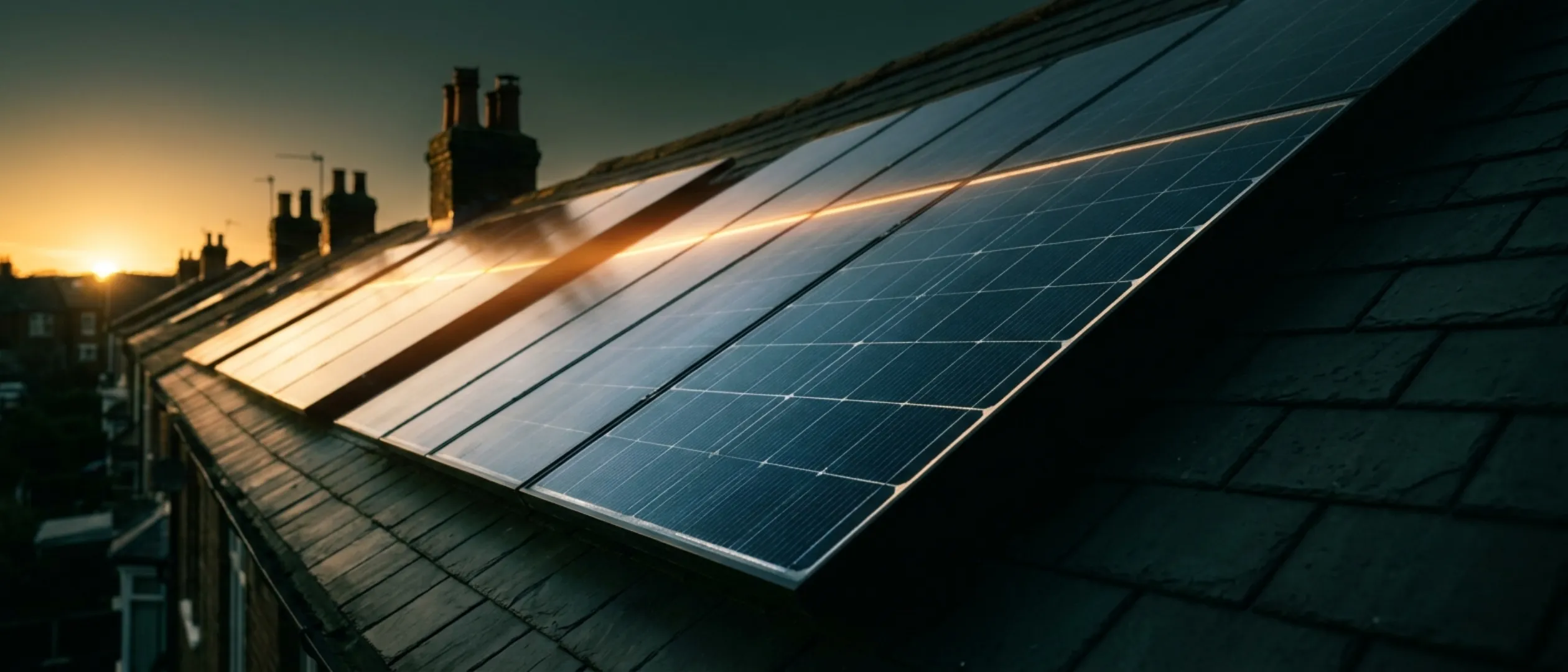
The first question is whether your roof can make solar worthwhile, and the honest answer is that most UK homes can. What matters most is which way your roof faces, how steep it is, and whether anything shades it during the day.
South-facing is the ideal, but east or west-facing roofs still generate around 80 percent as much over a year, so they are well worth doing. North-facing slopes are the one orientation usually not worth it on their own. A pitch somewhere between 30 and 40 degrees is close to perfect, though anything from flat to fairly steep works with the right mounting. Shade is the bigger enemy. A chimney, a tall tree or a neighbouring building that sits over the panels for part of the day costs you more than most people expect.
Your property type sets the rough size of system that fits. A terraced house might take a 2 to 4 kW system, a semi 3 to 5 kW, and a detached house 4 to 8 kW or more. The amount of roof you have, not just how much electricity you use, often decides the ceiling.
Work through suitability for your roof and property typeWhat it costs, and what comes back
A typical 4 kW system, around 10 panels, costs roughly £6,000 to £8,000 fully installed. Smaller systems cost more per panel because the fixed costs, the scaffolding, labour and paperwork, are spread over fewer panels. Solar is 0% VAT in Great Britain until 31 March 2027.
| System size | Panels | Typical installed cost |
|---|---|---|
| 3 kW | About 8 | £4,500–£6,000 |
| 4 kW | About 10 | £6,000–£8,000 |
| 6 kW | About 15 | £8,000–£11,000 |
What comes back has two parts. Every unit you generate and use yourself is one you do not buy from your supplier, which is worth about 25 pence at current prices. Every unit you generate but do not use is exported to the grid, and the Smart Export Guarantee pays you for it, usually a few pence a unit. That gap is why using your own solar matters so much, and why payback is faster for homes that are busy during the day.
For a typical home, payback lands somewhere around 10 to 15 years, with the panels themselves expected to keep working well beyond 25. The number moves a lot with how much electricity you use in daylight, so a national average is close to useless. The estimate below works the figures for your own roof and usage.
See the numbers for your roof
Put in your postcode and a couple of details for a rough idea of system size, output and payback. About a minute.
Can you get a grant?
The honest answer is that most people pay for solar themselves. The one saving everyone gets is 0% VAT, which applies to solar, and a battery fitted at the same time, in Great Britain until 31 March 2027. After that it is due to return to 5 percent.
Beyond VAT, the national grant schemes are limited and aimed mainly at lower-income households. ECO4 and local council schemes can fund measures that sometimes include solar for eligible homes, usually based on your income and how energy-efficient your home is. Some areas run their own schemes too, so it is worth a quick check of what is live where you live, without assuming there is free money on the table.
Separate from any grant, the Smart Export Guarantee pays you for the electricity you send back to the grid once your system is certified. It is income rather than a grant, but it is part of the overall picture.
What grants and schemes actually existShould you add a battery?
A battery stores the solar you generate in the day so you can use it in the evening, rather than exporting it for a few pence and buying it back later at full price. It lifts the share of your own solar you actually use, which is where most of the value is.
It is a separate decision from the panels, and a separate sum. A battery adds roughly £2,000 to £4,000 for around 5 kWh, or £4,000 to £7,000 for around 10 kWh, and it pays back more slowly than the panels do. It makes most sense if you are out during the day, use a lot of electricity in the evening, or want to charge from cheap overnight tariffs as well as from solar. If you are home and using power while the sun is up, the case is weaker.
Work out whether a battery is worth it for youDo you need permission?
For most homes, no. Solar on a typical house counts as permitted development, so you do not need planning permission as long as the panels sit reasonably close to the roof and do not stick out past the highest part of it. The common exceptions are listed buildings, homes in conservation areas or under an Article 4 direction, and flat roofs, where the rules are tighter and you should check before you commit.
There is a second piece of paperwork that applies to everyone, and your installer handles it. The grid operator for your area, the DNO, has to be told about your system. For most home-sized installs this is a simple notification after the work, not an application you wait on. Larger systems may need approval first.
Check the planning rules and the grid connectionGetting it installed
Once you decide to go ahead, the work is carried out by MCS-certified installers. MCS is the standard you need for Smart Export Guarantee payments and most grants, so it is worth more than a badge. Here is how the install itself usually runs.
- 1
Survey
A surveyor checks the roof, the loft, your fuse board and the best layout for panels. This confirms the system design and the final quote, and flags anything unusual before work starts.
- 2
Scaffolding
On a normal two-storey house, scaffolding goes up a day or two beforehand for safe access. It is included in a standard quote and comes down shortly after the work is done.
- 3
Fitting the panels
Mounting rails are fixed to the rafters, then the panels go on top and are wired together. This is the part most people picture, and it is usually the quickest.
- 4
Inverter and wiring
The inverter, which turns the panels’ DC into the AC your home uses, is fitted, along with any battery, the generation meter and the connection into your fuse board.
- 5
Testing and sign-off
The system is tested, commissioned and registered for MCS certification. You get the paperwork you need, including the certificate for Smart Export Guarantee payments.
- 6
Grid notification
Your installer notifies the local grid operator (the DNO) that the system is connected. For home-sized systems this is a formality they handle for you.
Start to finish, from first enquiry to a working system, is usually four to eight weeks, most of it scheduling rather than work. The time on your roof is typically one to two days.
Living with solar
Once it is on, solar mostly looks after itself. There are no moving parts in the panels and very little to do. Most owners check an app now and then to see what they are generating and using, and otherwise leave it alone.
Maintenance is light. Rain keeps panels clean enough in most places, so a wash is only needed if they get visibly dirty. The one part that does not last the full life of the system is the inverter, which typically needs replacing once over 25 years, at a few hundred to around a thousand pounds. Panels themselves usually carry performance warranties of 25 years or more and keep working after that, just a little less efficiently each year.
The last step is getting paid for what you export. After your system is certified, you sign up with a Smart Export Guarantee supplier, who pays you for each unit you send back to the grid. It does not have to be the same company that supplies your electricity, so it is worth comparing rates.
What looking after a system actually involvesCommon questions
- How long does the whole process take?
- From first enquiry to a working system is usually four to eight weeks. Most of that is scheduling and paperwork. The install itself is typically one to two days on the roof.
- Do I need to be home for the installation?
- Someone needs to be there to give access at the start and end of each day, and for the survey. The installers do not need you watching over them while they work.
- Will I need scaffolding?
- Almost always, yes, on a normal two-storey house. It is there for safe access and is included in a standard quote. It usually goes up a day or two before and comes down shortly after.
- What maintenance do solar panels need?
- Very little. They have no moving parts. An occasional rinse if they get visibly dirty, and an inverter replacement at some point over the system life, are about all most homes need.
- How do I get paid for the electricity I export?
- Through the Smart Export Guarantee. You sign up with an SEG supplier after your system is certified, and they pay you for each unit you send back to the grid. Your installer registers the system and gives you the certificate you need.
Sources
Ready to see your own numbers?
Answer a few quick questions and we will model the likely cost, savings and payback for your roof. Free, no obligation, and you decide in your own time.