Commercial solar
Solar panels for office buildings
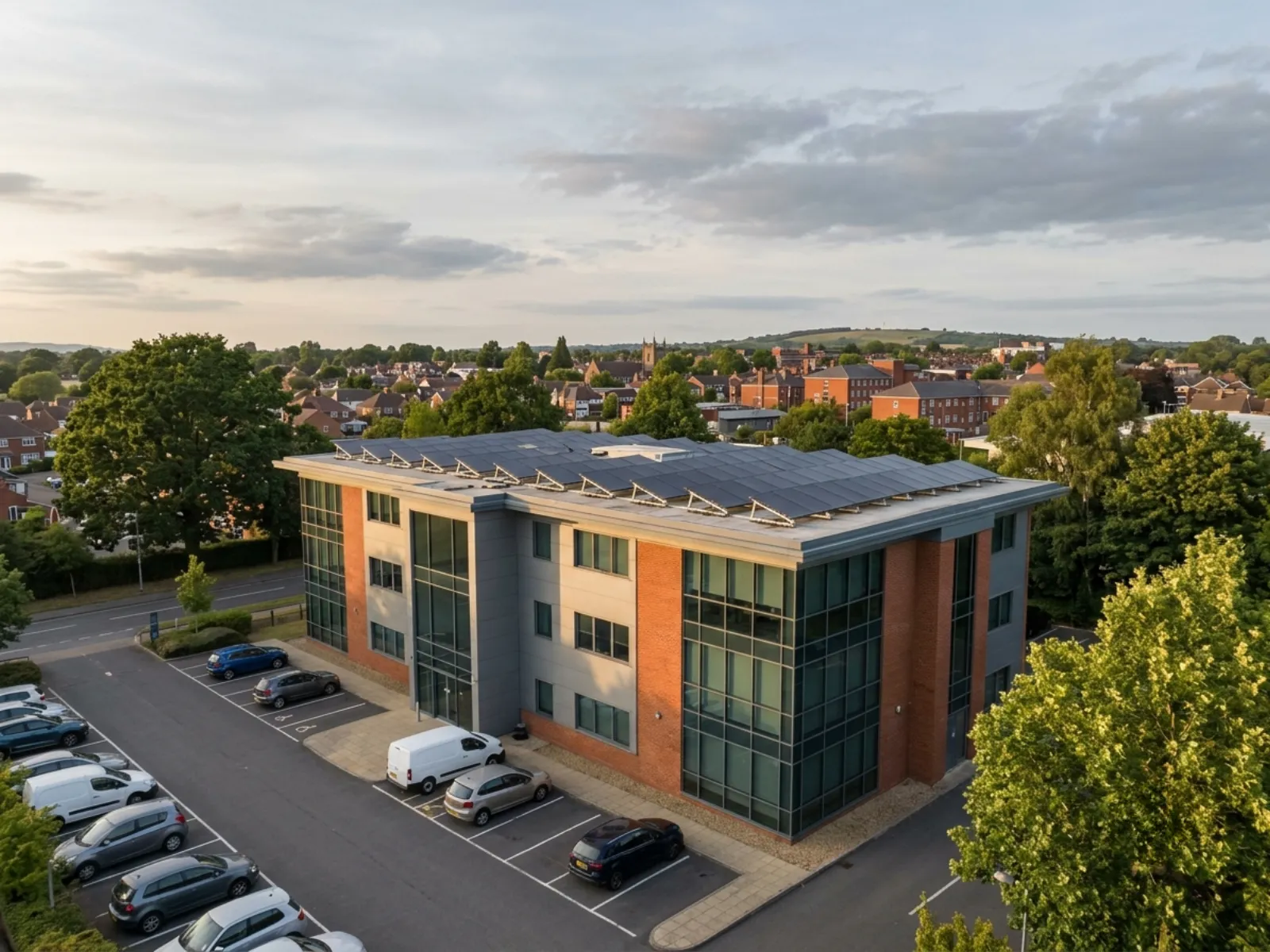
An office has a smaller roof relative to its floor area, so solar covers a share of your electricity rather than all of it. The upside is timing: a nine-to-five day lines up neatly with when the panels generate.
- Accredited installers
- No obligation
- UK-wide
- typical system
- 10–50 kWp
- typical payback
- ~7–9 yrs
- the extra driver
- EPC & ESG
Why solar suits an office
Lighting, IT, servers and air conditioning run through the working day, so a good share of the generation is used on site rather than exported. The load tails off in the late afternoon and drops at weekends, so an office self-consumes less than a factory, and the system is best sized to match your weekday daytime baseload rather than to fill the roof.
The other driver for offices is not just the bill. On-site generation feeds into the SBEM calculation behind a commercial EPC, so it can help your rating and MEES position, and it is a visible, measurable step for ESG reporting and tenders. We keep that qualitative rather than promising a specific band change.
A worked example
Take a 30 kWp system on an office roof, costing around £36,000.
- about 75 panels
- 30 kWp
- kWh a year
- ~27,000
- saved a year
- ~£4,300
- payback
- ~7–8 yrs
It generates roughly 27,000 kWh a year. A weekday office uses a bit over half of that on site, worth around 25p a unit, and exports the rest at the Smart Export Guarantee rate, which comes to about £4,300 a year.
Sizing matters more here than in most sectors: a system matched to your daytime baseload self-consumes a higher share than one that fills the roof and exports the surplus cheaply at the weekend. The assessment works to your actual usage.
Assumes a business electricity price of about 25p a unit (DESNZ Quarterly Energy Prices), export at around 5p a unit through the Smart Export Guarantee, and a yield of about 900 kWh per kWp a year. Your own figures depend on your roof, tariff and usage. Reviewed July 2026.
What a survey checks
The usable roof, its structure, and any shading from taller neighbours or plant, plus your weekday demand profile. Flat office roofs are common and use tilted frames, subject to the loading check.
Multi-tenant and let buildings need agreement on who funds the system and who benefits, since the meter arrangement decides who uses the generation. It is worth settling that with the landlord or other tenants early.
How you pay
Buying outright keeps the saving and can qualify for capital allowances. On a smaller office system the numbers are modest, so finance or a lease can make sense to keep it cash-neutral, and a PPA removes the upfront cost entirely.
Common questions
- Does solar improve our EPC?
- It can help. Commercial EPCs are produced using the SBEM calculation, which factors in on-site generation, so solar contributes to the modelled energy performance and your MEES position. The exact effect depends on your building and is a model output, not a fixed number of bands, so we do not promise a specific jump.
- We are in a multi-tenant building. How does that work?
- It comes down to the metering and who pays. If the landlord owns the roof and common supply, the system usually offsets landlord or communal power; offsetting individual tenants’ use needs the right meter arrangement. It is a solvable question, but one to agree between landlord and tenants before sizing.
- How much roof do we need?
- As a rough guide, each usable square metre of roof takes a little under a fifth of a kW, so a 30 kWp system needs roughly 150 to 200 square metres of clear roof. Offices tend to have less roof per person than industrial sites, which is why solar typically covers a share of the load rather than all of it.
- Is it worth it for a smaller office?
- It can be, but the case is tighter than for a factory or warehouse, because offices self-consume less and have smaller roofs. Payback is often in the seven to nine year range. Where it earns its place is the combination of a steady daytime load, the EPC and ESG benefit, and a fixed, predictable slice of your energy cost.
Sources
Reviewed by Daniel Osei · Last checked July 2026. Funding and tax rules change, so we re-check this page regularly and date it when we do.
See whether solar stacks up for your site
Tell us about your building and roughly what you spend on electricity, and we will help you work out the cost, output and return. Free, no obligation, and the work is carried out by accredited installers.