Solar panels · Greater Manchester
Solar panel installation in Manchester
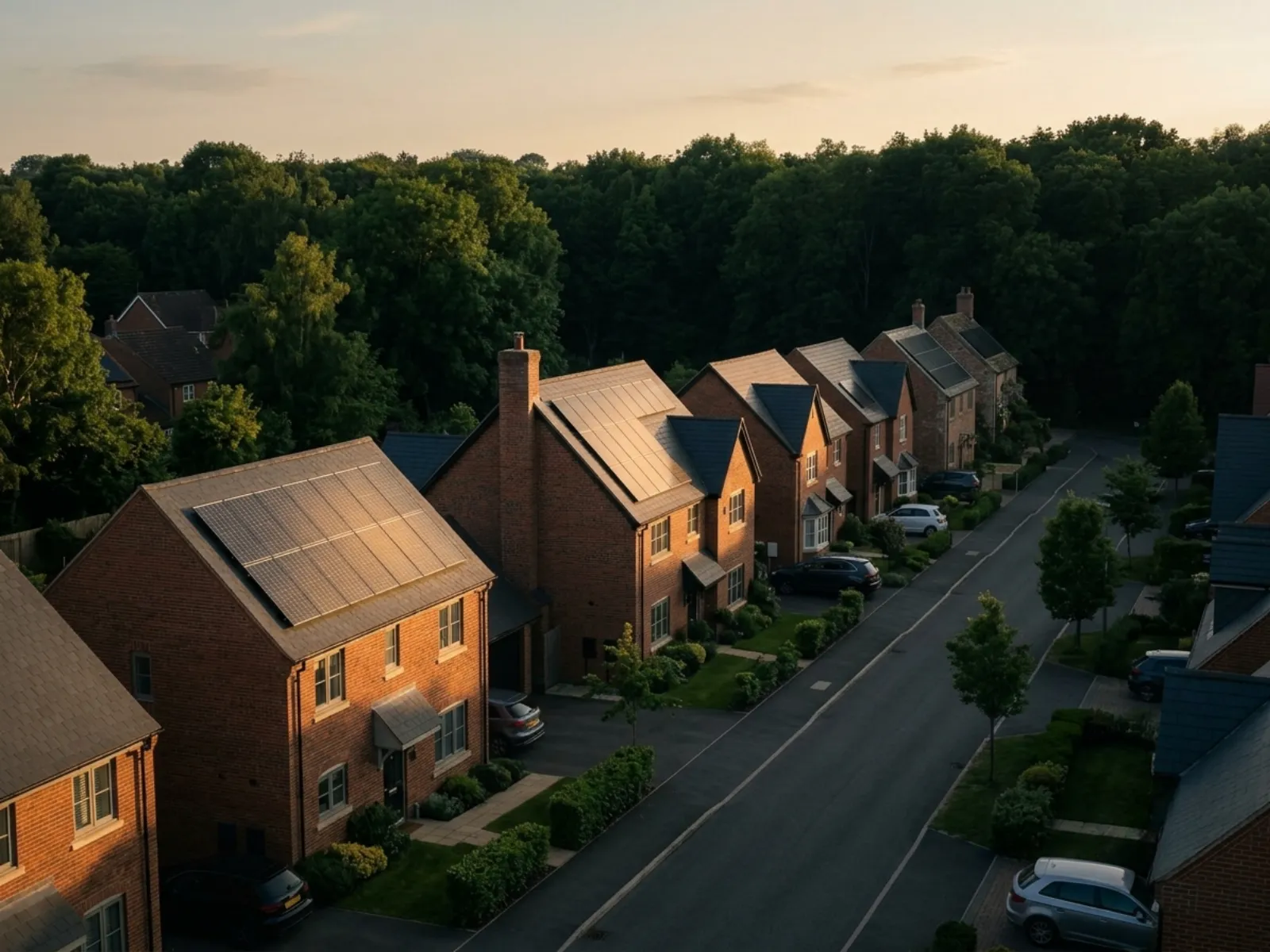
Solar panel installation in Manchester mostly comes down to the roof. The Victorian terraces and villas of Chorlton, Didsbury and Withington suit anything from 3 kWp upward, while the simpler post-war roofs out at Wythenshawe are often close to ideal. Most homes are permitted development, but the conservation areas at Didsbury St James, Chorlton Green and Victoria Park usually need permission for a front-facing array. The work is carried out by MCS-certified installers covering Manchester.
- MCS-certified installers
- 0% VAT until 2027
- Covering Manchester
- generation
- ~950 kWh per kWp a year
- typical system
- 3 to 4 kWp
- grid operator
- Electricity North West
- payback
- ~10 to 15 years
The quick version
- A well-sited Manchester roof generates around 900 to 1,000 kWh a year for each kWp, close to the UK average, so a typical 3 to 4 kWp system is well worth doing.
- Manchester is covered by Electricity North West, who your installer notifies about the connection.
- Funded help runs through Greater Manchester’s ECO4 Flex and retrofit advice, which are means-tested. There is no open Manchester-only solar grant to assume.
- Several suburbs are conservation areas (Didsbury St James, Chorlton Green, Victoria Park, Ancoats, Withington), where front-roof solar often needs planning permission.
- Solar is 0% VAT until 31 March 2027, and payback is usually around 10 to 15 years.
What solar generates in Manchester
A well-sited Manchester roof generates roughly 900 to 1,000 kWh a year for each kWp installed. That is close to the UK average and a little below the sunniest parts of the South West, but well within the range that makes solar worth doing.
Orientation and shading matter more than Manchester’s reputation for rain. South is ideal, east or west still does around 80 percent as much over a year, and the biggest lever on payback is how much of your own solar you use rather than export.
The homes here
Manchester’s housing runs from dense inner terraces to garden-suburb semis, and the roof usually sets the system size. The south Manchester suburbs, Chorlton, Didsbury, Withington and Fallowfield, are a mix of Victorian terraces, semis and larger villas. A terrace normally suits around 3 to 4 kWp on its best slope, while a semi or detached house with more roof can take more.
Elsewhere the picture changes again. Wythenshawe is a large post-war estate of semis and terraces with simpler, more uniform roofs that are often well suited to solar, while areas like Ancoats and the city fringe have their own conservation constraints to check.
Grants and funding in Manchester
Most Manchester homeowners pay for solar themselves. There is no open Manchester-only solar grant to assume. The funded help that exists is means-tested and runs through Greater Manchester’s ECO4 Flex route, aimed at lower-income households and less efficient homes. Greater Manchester’s Your Home Better service offers retrofit advice and access to vetted installers rather than a grant.
So it is worth checking what is live with Manchester City Council and the Combined Authority, but not something to bank on. Whichever way you pay, solar is 0% VAT until 31 March 2027, and the Smart Export Guarantee pays you for what you export.
Planning and conservation in Manchester
For most Manchester homes, solar is permitted development and needs no planning application. The exception is the conservation areas, which Manchester City Council lists across the city, including Didsbury St James, Chorlton Green and Chorltonville, Victoria Park in Rusholme, Ancoats and Withington.
In these areas, panels on a front-facing roof usually need planning permission, and a rear slope is often the simpler route. Listed buildings need consent wherever the panels go. Elsewhere, most roofs are permitted development, so it is worth a quick check on whether your street is affected before you commit.
Your grid connection
Manchester is covered by Electricity North West, the network operator for most of the region. For a typical home-sized system, connecting is a simple notification your installer makes after the work, not an application you wait on. Larger systems may need approval first, which your installer handles either way.
What it could mean for your home
- about 10 panels
- 4 kW
- kWh a year
- ~3,700
- a year, typical
- £450–700
Take a typical three-bedroom semi in Chorlton or Didsbury. A 4 kWp system, about ten panels, generates roughly 3,600 to 3,800 kWh a year on a decent Manchester roof. How much that saves you depends mostly on when you use electricity. Every unit you use as it is generated is worth about 25 pence off your bill, while every unit you export earns a few pence through the Smart Export Guarantee.
In practice that tends to be somewhere around £450 to £700 a year, at the higher end if you are home in the day or add a battery. Against a typical installed cost of £6,000 to £8,000, that is a payback of roughly 10 to 15 years, on panels that keep working well beyond 25. The estimate on this page works the numbers for your own roof and usage.
Common questions
- Is solar worth it in Manchester?
- Yes for most homes. A roof here generates roughly 900 to 1,000 kWh per kWp a year, so a typical 3 to 4 kWp system pays back over around 10 to 15 years, faster if you use a lot of electricity during the day.
- Do I need planning permission for solar in Manchester?
- Usually not. Most installs are permitted development. But in the conservation areas, such as Didsbury St James, Chorlton Green, Victoria Park, Ancoats and Withington, panels on a front-facing roof can need permission. Listed buildings always need consent. Check before you commit.
- Can I put solar on a Manchester terrace?
- Usually yes. A terrace normally has one good roof slope, which suits a system of around 2 to 4 kWp. The things to check are shading from neighbouring roofs and, in the inner suburbs, whether your street is in a conservation area.
- Are there grants for solar in Manchester?
- Only means-tested ones. Greater Manchester runs ECO4 Flex and retrofit advice for lower-income households and less efficient homes, and solar is not guaranteed under them. There is no open Manchester-only solar grant, so most homeowners self-fund. Solar is 0% VAT until 31 March 2027.
- How much can I earn from exporting electricity in Manchester?
- Through the Smart Export Guarantee, you are paid for each unit you send back to the grid, usually a few pence per unit. Using your own solar is worth far more, so the aim is to use as much as you can yourself. Your installer registers the system so you can sign up.
- How long does installation take?
- From first enquiry to a working system is usually four to eight weeks, most of it scheduling. The time on your roof is typically one to two days.
- Who installs the panels?
- The work is carried out by MCS-certified installers covering Manchester. MCS is the standard required for Smart Export Guarantee payments and most grants.
Reviewed by Daniel Osei · Last checked 1 July 2026
Sources
What happens next
- 1
Get your estimate
Answer a few quick questions for a rough idea of system size, cost and payback for your Manchester roof. It takes about two minutes.
- 2
Compare a proper quote
If the numbers stack up, you get a real quote to weigh against the estimate. You decide in your own time, with no obligation.
- 3
Installed by MCS-certified installers
The work is carried out by MCS-certified installers covering Manchester, who handle the survey, the fitting and the grid paperwork.
See what solar would do for your Manchester home
Answer a few quick questions and we will model the likely cost, savings and payback for your roof. The work is carried out by MCS-certified installers covering Manchester.